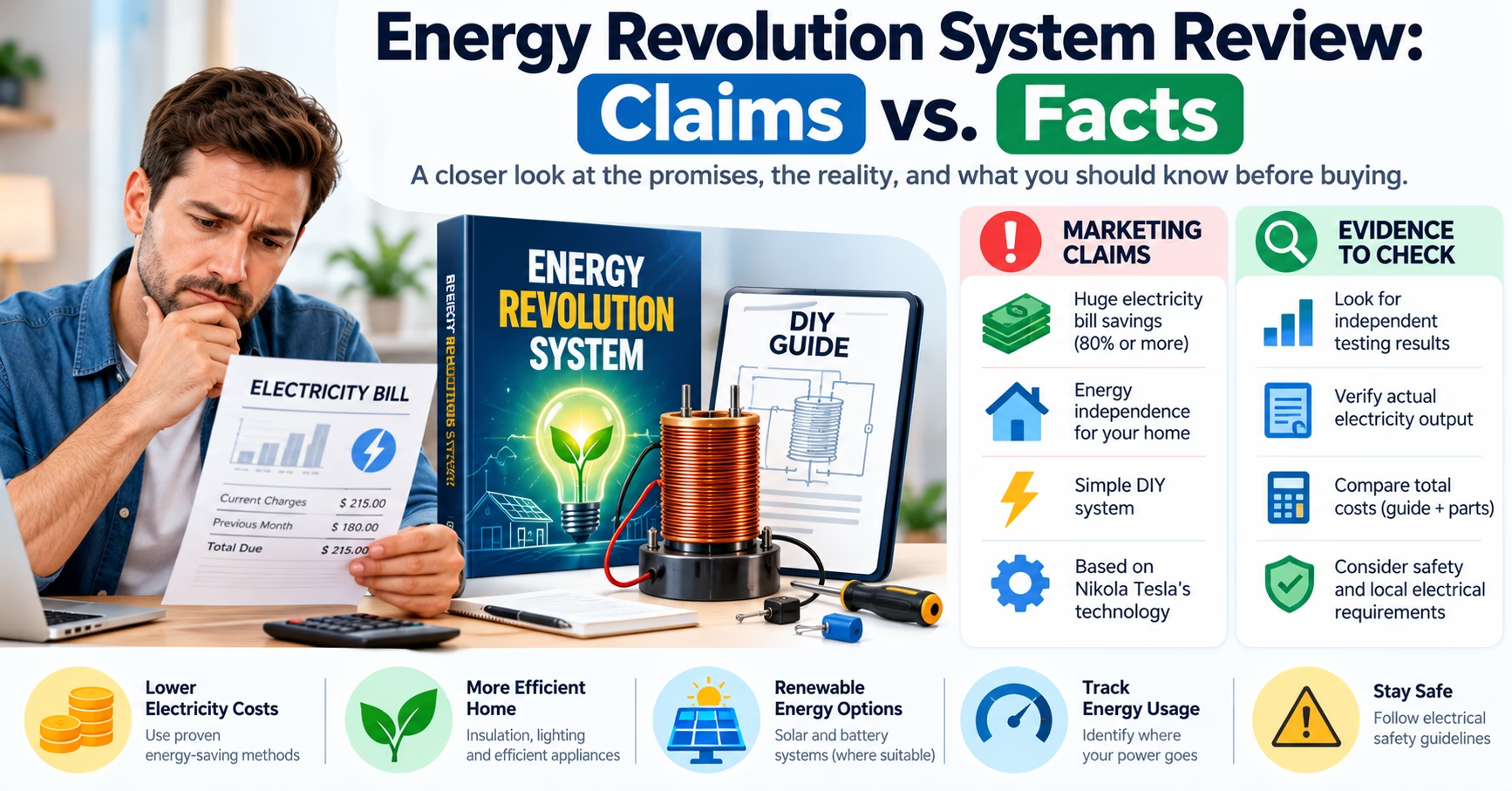
Rising electricity bills can put a real strain on a household budget. Between air conditioning, heating, refrigerators, lighting, and everyday electronics, keeping a home comfortable can become expensive, particularly during extreme summer and winter weather. It is understandable that homeowners are looking for ways to use less electricity without making major changes to their homes.
That is where the Energy Revolution System comes in. Promoted through online videos and sales pages, this offer claims to explain a DIY approach to generating power and reducing household electricity expenses. Some promotional materials make dramatic savings claims, suggesting that people may be able to cut their electricity bills by as much as 80% or more.
Those promises sound attractive, but do they hold up under closer examination?
Before spending money on an energy-saving product, it is important to understand exactly what you are buying, what evidence supports its claims, whether additional equipment is required, and what alternatives might provide more dependable results.
This Energy Revolution System review examines the product’s advertised features, digital materials, potential costs, scientific questions, safety considerations, and practical alternatives. It also considers the information available from the seller and independent sources so that readers can make a more informed decision.
Affiliate Disclosure: This article contains affiliate links. If you purchase through these links, we may earn a commission at no additional cost to you. This does not guarantee a positive review or mean that the product’s performance claims have been independently verified.
What Is the Energy Revolution System?
The Energy Revolution System is marketed as a DIY energy project designed to help people explore alternative electricity generation and potentially reduce their dependence on conventional power.
The promotional website presents the project as an accessible way for ordinary homeowners to learn about a different approach to producing electrical power. Its marketing refers to electromagnetic principles and Nikola Tesla’s historical work, using those ideas to explain the concept behind the proposed design.
However, there is an important distinction between the product’s marketing and what customers actually receive.
According to publicly available descriptions of the offer, the Energy Revolution System is primarily a digital instructional package, rather than a complete, ready-to-use household power device. The materials are described as including downloadable instructions, diagrams, a parts list, and guidance for assembling the proposed project.
That means purchasing the guide does not automatically provide everything needed to generate usable electricity. Anyone attempting the project may need to obtain separate components, tools, and other materials.
The difference matters because a digital guide and a functioning energy system are two very different purchases.
A guide can explain a concept or provide instructions. It does not, by itself, demonstrate that the finished construction will produce enough electricity to power household equipment or reduce a utility bill.
For someone interested in basic electronics, a DIY guide might have educational appeal. For a homeowner hoping to lower monthly expenses, stronger evidence of real-world performance is necessary.
Explore the Product Offer
If you are curious about the Energy Revolution System and want to examine the offer for yourself, you can review the available product information before making a decision.
View the Energy Revolution System Product Offer
Before purchasing, confirm the current price, exact package contents, additional costs, and applicable refund conditions.
What Does the Energy Revolution System Claim to Do?
The central marketing message is that the system could help people produce electricity at home while spending less on conventional power.
Its promotional materials emphasize several potential benefits.
1. Lower Household Electricity Bills
The most prominent claim is the possibility of reducing electricity expenses significantly.
Some advertisements use eye-catching percentage figures, including claims of savings approaching 80% or 85%. These are marketing claims, not independently verified results.
Actual electricity savings depend on several factors, including how much power a device produces, how efficiently it operates, the electricity it consumes while running, and how much utility power it genuinely replaces.
A device that generates a small amount of electricity for a low-power light will have a very different financial impact from a system capable of supplying a home’s major appliances.
Without independently verified measurements and realistic information about total project costs, it is not possible to conclude that the advertised savings are achievable for ordinary households.
2. An Alternative to Conventional Energy Sources
The sales presentation connects the project with the broader idea of home energy independence.
Reducing reliance on utility electricity can be useful during certain situations, particularly when a household has appropriately designed backup power or a renewable energy system.
However, energy independence requires more than a promising diagram. A usable system must generate sufficient electricity, provide the correct voltage and current, and operate safely under real household conditions.
Many homes need electricity for refrigerators, internet equipment, lighting, medical devices, heating, and cooling. Meeting those needs requires dependable power output, not simply a device that produces some electrical activity.
3. A DIY Project for Interested Homeowners
The instructional format may appeal to people who enjoy electronics, experimentation, and learning about electrical components.
A project can have educational value even when it does not become a practical source of household electricity.
That said, buyers should understand the difference between experimenting with a low-voltage educational circuit and connecting a homemade device to a home’s wiring. The latter involves additional electrical hazards and code requirements.
Anyone considering a DIY electrical project should review the design carefully and consult a qualified electrician before attempting any installation that could affect household wiring.
How Is the System Supposed to Work?
The Energy Revolution System’s marketing refers to electromagnetic principles and a coil design associated with Nikola Tesla.
To evaluate this explanation properly, it helps to understand the basic science involved.
Understanding Electromagnetic Induction
Electricity and magnetism are closely related. When magnetic fields change under the right conditions, they can induce a voltage in a conductor. This is one of the fundamental principles used in electrical generators and transformers.
A conventional generator converts mechanical energy into electrical energy. That mechanical energy may come from flowing water, wind, steam, or another source.
A solar panel works differently. It converts energy from sunlight into electrical energy through photovoltaic cells.
In both cases, there is an identifiable energy source.
A working energy system needs a source of energy, a mechanism for converting it, and a way to deliver usable electricity to a load.
What Is a Bifilar Coil?
A bifilar coil is a type of coil wound using two wires in a particular arrangement. Nikola Tesla’s historical work included a bifilar coil patent.
Such a coil can have different electrical characteristics from a conventional coil. Its behavior depends on its design, wiring, materials, frequency, and the surrounding circuit.
The existence of a legitimate historical design, however, does not establish that a modern DIY device can generate electricity without an external energy source.
Energy storage, energy transfer, and energy generation are different concepts.
A component may influence how energy behaves within a circuit, but that does not mean it can produce an unlimited supply of new energy.
The marketing’s references to Tesla and electromagnetic principles should therefore be evaluated separately from the product’s performance claims.
Does the Energy Revolution System Really Save Electricity?
This is the most important question for anyone considering the purchase.
There is insufficient independently verified evidence to establish that the Energy Revolution System can deliver the dramatic household electricity savings advertised.
That does not mean every individual component described in a DIY electronics project is ineffective. It means the specific performance claims need evidence before consumers should rely on them.
To establish that a new system reduces electricity costs, a meaningful evaluation would need to measure its real electrical output, energy input, operating losses, and long-term reliability.
It would also need to establish whether the device can supply the types of loads being discussed in the advertisements.
For example, imagine that a household uses 900 kilowatt-hours of electricity in one month. A genuine 80% reduction would mean replacing 720 kilowatt-hours of utility electricity or eliminating that amount of consumption through verified efficiency improvements.
That is a substantial amount of energy.
Producing enough electricity to make a measurable difference would require a system with appropriate capacity, reliable output, and a practical method of supplying household circuits or appliances.
A video demonstration showing a light turning on would not, on its own, establish that a device can achieve this level of performance.
Why Independent Testing Matters
A convincing demonstration should provide measurable results rather than relying exclusively on testimonials or dramatic storytelling.
Useful evidence would include:
- The amount of electrical energy generated over a defined period.
- The energy consumed by the device itself.
- Voltage, current, power output, and operating conditions.
- Testing by a qualified, independent laboratory.
- Repeated results under clearly described conditions.
- A comparison of total costs with the financial savings actually achieved.
A seller’s own demonstration may provide information, but it should not be treated as independent proof.
I could not establish the advertised savings percentages from the available independent evidence reviewed for this article. Consequently, those figures should not be used to calculate an expected return on investment.
The Federal Trade Commission has also warned consumers about energy-related products promoted with exaggerated or implausible savings claims. Its guidance recommends examining the evidence and being cautious about promises that seem too good to be true.
What Do You Receive When You Buy It?
Because the Energy Revolution System is advertised as a digital package, it is worth understanding what that means before placing an order.
Public descriptions of the offer list instructional materials such as:
- Digital blueprints and diagrams.
- A manual or assembly instructions.
- A list of parts and components.
- Guidance for putting the proposed project together.
- Additional instructional materials described by the seller.
The exact contents, access arrangements, and included extras should be confirmed on the checkout page before purchasing.
Do not assume that the offer includes a fully assembled generator, solar panels, batteries, an inverter, or equipment capable of powering a whole home.
The materials reviewed describe a guide-based product, and physical construction components must be sourced separately.
This is an important consideration for anyone comparing the system with commercially available backup batteries or renewable energy equipment.
Those products may come with specified electrical ratings, installation instructions, warranties, and technical documentation. A set of blueprints has a different purpose and should be assessed accordingly.
If you expect to receive a physical device that you can plug in immediately, read the product description and order terms carefully to avoid a misunderstanding.
Check the Current Offer Before Buying
Before making a decision, review the seller’s product information and confirm what the purchase actually includes.
Check the Energy Revolution System Product Details
Pay attention to the following:
- Is the offer a digital guide or physical equipment?
- What instructions and materials are included?
- Are there optional upgrades?
- Are additional components necessary?
- What is the total purchase price?
- What are the refund conditions?
Reading these details can help you avoid unexpected expenses or unrealistic expectations.
How Much Does the Energy Revolution System Cost?
The overall financial commitment may include more than the initial price displayed in an advertisement.
The total cost can potentially include the digital guide, separately purchased parts, tools, electrical testing equipment, and professional assistance where required.
The price shown on a sales page may also change over time. A crossed-out reference price or a limited-time offer should not be treated as proof that a product offers good value.
Before paying, check the following details.
The initial purchase price: Confirm the amount charged for the main digital package.
Additional offers: Review any optional upgrades or add-ons presented during checkout. Confirm which items are optional and what each one costs.
Construction costs: If you intend to build the project, identify the full parts list and obtain realistic local prices before proceeding.
Refund conditions: Read the current refund policy, eligibility requirements, time limit, and procedure. Keep your order confirmation and payment records.
Recurring payments: Check whether any subscription or recurring billing arrangement applies.
Support arrangements: Determine who handles technical questions, download problems, and refund requests.
A low initial price does not automatically make a project inexpensive if the required components are costly or its performance remains uncertain.
Likewise, a refund policy is not evidence that a product’s technical claims are correct. It is a separate part of the purchase decision.
I would not calculate potential savings or a break-even period for this product without reliable performance data and verified total costs.
Advantages and Disadvantages: An Honest Assessment
A balanced review should consider what may be useful about an offer as well as its limitations.
Potential Advantages
Digital access: A downloadable guide can be convenient for someone who prefers reading instructions and learning at their own pace.
Educational interest: The project may interest hobbyists who want to explore basic electrical concepts and coil designs.
A starting point for research: The materials may introduce readers to terminology related to electromagnetism and alternative energy projects.
Self-paced learning: A digital format may allow readers to study the materials at a convenient time.
These potential advantages concern convenience and educational interest. They should not be confused with evidence of substantial household savings.
Potential Disadvantages
Unverified savings claims: The dramatic percentages in the marketing have not been established by independent testing reviewed for this article.
Additional expenses: A digital guide does not necessarily include the physical parts needed for construction.
Uncertain practical output: The available information does not establish whether a finished build can supply meaningful amounts of household electricity.
Limited verifiable technical information: Buyers should look for independently measured output, detailed performance specifications, and evidence of reliable operation.
Electrical safety concerns: An experimental build can introduce risks if it is assembled incorrectly or connected to household wiring without appropriate expertise.
Uncertain financial return: Without credible output measurements and a complete cost estimate, it is difficult to assess whether the project would save money.
For a person seeking an educational electronics project, these limitations may be evaluated differently from those of a homeowner who simply wants a lower utility bill.
For the latter, the lack of independent performance evidence is a substantial concern.
Is the Energy Revolution System Legitimate or a Scam?
It is reasonable to ask this question before purchasing a product promoted through dramatic online advertisements.
A careful answer requires separating several issues: whether a digital product is offered for sale, whether its instructions provide educational value, whether its performance claims are accurate, and whether consumers can obtain the outcome they expect.
Those questions are not interchangeable.
The existence of a checkout page does not prove that a product delivers its advertised results. Equally, a product should not be declared fraudulent solely because its marketing sounds unusual without examining the available evidence.
In this case, there are reasons to be cautious.
A November 2025 investigation by Jordan Liles examined the Energy Revolution System’s advertising and raised concerns about its savings claims, sales presentation, and use of a story involving Nikola Tesla. The investigation concluded that the promotional claims were not supported by reliable evidence.
A separate 2026 consumer guide reported that the seller’s materials describe the product as an experiment that has not been independently technically assessed. It also noted that the sales presentation is characterized as promotional material in the seller’s disclosures.
These findings are reasons to investigate carefully, not a substitute for reviewing the precise terms of the offer you are considering.
The seller’s own disclosures, the limits of independent verification, and the difference between an instructional guide and a working home power system deserve serious attention.
Warning Signs to Consider
Be particularly careful when a product’s marketing relies on:
- Very large savings percentages without independently verified measurements.
- Claims that a hidden invention can fundamentally change electricity generation.
- Stories suggesting that corporations have suppressed a breakthrough without persuasive evidence.
- Dramatic testimonials that do not explain the user’s actual equipment, energy consumption, or testing method.
- Urgent countdowns or pressure to purchase before researching the product.
- A presentation that emphasizes a finished device while the actual offer is a digital guide.
None of these points alone proves that every part of a product is worthless. Together, however, they make independent verification especially important.
The FTC recommends checking companies and products before buying, looking for reviews and complaints, and being wary of overstated energy-saving promises.
My Assessment
I would not recommend buying the Energy Revolution System solely on the expectation that it will reduce a household electricity bill by 80% or 85%.
Those results have not been independently established by the evidence reviewed here.
Anyone considering the product should first decide whether an experimental digital guide is worth its cost even if it produces no meaningful reduction in household expenses.
If your main objective is predictable financial savings, there are better-documented options to evaluate first.
Energy Revolution System vs. Practical Ways to Save on Electricity
For homeowners who want to reduce monthly expenses, established energy-efficiency measures offer a more evidence-based starting point.
The best option depends on your home’s condition, local climate, utility rates, and the appliances that consume the most electricity.
1. Reduce Heating and Cooling Waste
Heating and cooling can account for a substantial share of household energy consumption.
Check the condition of insulation, exterior doors, windows, and exposed ductwork. Air leaks may allow conditioned air to escape, forcing heating and cooling systems to work harder.
Simple improvements such as appropriate weatherstripping, sealing suitable gaps, and maintaining HVAC equipment can help reduce unnecessary energy use.
The U.S. Federal Trade Commission recommends home energy assessments, checking insulation and air leaks, and maintaining heating and cooling equipment. A local utility may offer a free or low-cost assessment.
2. Use More Efficient Lighting
Replacing frequently used incandescent bulbs with suitable LED bulbs can reduce the electricity required for lighting.
Consider a room where a 60-watt bulb operates for five hours each day.
Its daily energy use is:
60 watts × 5 hours = 300 watt-hours, or 0.3 kilowatt-hours.
A 9-watt LED providing suitable lighting for the same five hours uses:
9 watts × 5 hours = 45 watt-hours, or 0.045 kilowatt-hours.
The difference is 0.255 kilowatt-hours per day for that bulb.
Actual savings depend on the bulbs’ specifications, operating hours, and local electricity rates. Still, the calculation illustrates how measurable efficiency improvements can reduce consumption.
3. Track Electricity Usage
Your utility bill and meter can help identify patterns that are easy to overlook.
Compare monthly consumption rather than looking only at the amount charged. Rates, fixed fees, seasonal usage, and other billing details can affect the total.
If your bill rises sharply, examine likely causes such as longer air-conditioning use, electric heating, additional occupants, or a change in utility rates.
A plug-in energy monitor can help measure some compatible appliances, provided it is used within its rated limits and according to the manufacturer’s instructions.
4. Choose Energy-Efficient Appliances
When replacing an old appliance, compare energy consumption as well as the purchase price.
For applicable products, ENERGY STAR certification and energy-use labels can provide useful information for comparing models.
A cheaper appliance may cost more to operate over several years, while a more efficient model may gradually offset part of its higher purchase price.
The right decision depends on the product’s actual energy use, initial cost, expected lifespan, and your household’s usage.
5. Consider Solar or Battery Storage Where Appropriate
For homeowners with suitable roofs or property, solar panels can generate electricity from sunlight. A properly designed battery system can store some energy for later use.
However, the economics depend on equipment costs, installation, available sunlight, electricity rates, local rules, and utility compensation arrangements.
Get written estimates from qualified installers, check relevant permits, and compare expected production with your household consumption.
Battery storage is not automatically a money-saving investment in every location, and solar panels do not make a home independent of the grid under all conditions.
These technologies are more established than unverified energy-generation claims, but the numbers should still be evaluated for your particular home.
Safety Considerations Before Building Any DIY Energy Device
Electricity can cause burns, electric shock, fires, and equipment damage. A project that appears straightforward in a video may present risks when assembled with different components or used in an actual home.
Read the complete instructions before buying parts. Understand the specified voltage, current, power ratings, insulation requirements, and operating conditions.
Do not connect an experimental device to household wiring, modify a breaker panel, or bypass protective equipment without the appropriate qualifications and legally required approvals.
Never assume that a small device is automatically safe. Batteries, capacitors, coils, and other components can behave differently depending on their design and how they are connected.
If a project requires work beyond your training, seek help from a qualified electrician or electronics professional.
For homeowners in the United States, local codes and permit requirements can vary. Verify the rules that apply to your property before making electrical modifications.
Safety is particularly important if a project is advertised as an inexpensive alternative to professional equipment. Avoid taking risks with household wiring to test an unverified financial claim.
Who Might Consider the Energy Revolution System?
The product’s suitability depends largely on what you want to accomplish.
Electronics Hobbyists
People who enjoy learning about circuits and experimenting with electrical components may find the instructional concept interesting.
They should approach it as an educational project and investigate the technical details before purchasing. It is wise to assess the guide’s value separately from any claims about financial savings.
Homeowners Seeking Lower Bills
If your priority is to lower utility expenses, I would begin with an energy assessment, appliance-efficiency improvements, lighting upgrades, and heating or cooling maintenance.
These options allow you to identify specific sources of electricity consumption and compare changes using measurable information.
The Energy Revolution System should not be treated as a proven substitute for those measures.
People Looking for Emergency Power
Emergency preparedness requires equipment with dependable, documented performance.
Before purchasing backup power equipment, determine which devices need electricity, how much power they require, and how long you need them to operate.
Compare equipment using its rated output, usable capacity, safety protections, operating limitations, and warranty.
A DIY guide with unverified output should not be relied upon to keep essential equipment running during an outage.
Frequently Asked Questions
What Is the Energy Revolution System?
The Energy Revolution System is marketed as a DIY energy project. Public descriptions indicate that the offer primarily consists of digital instructions and design materials rather than a complete, ready-to-use household generator.
Can the Energy Revolution System Reduce Electricity Bills by 80%?
That level of savings has not been independently established by the evidence reviewed for this article. The percentage appears in promotional material and should not be interpreted as a typical or guaranteed result.
Is the Energy Revolution System a Physical Product?
The available descriptions identify it as a digital package containing instructional materials. Buyers should verify the exact contents of the current offer before placing an order.
Do I Need to Buy Additional Parts?
You may need separate physical components, tools, or other materials to attempt the project. Confirm the complete parts list and estimate the total cost before purchasing the guide.
Does the System Use Nikola Tesla’s Technology?
The marketing refers to Tesla’s historical work on a bifilar coil. The existence of that coil design does not establish that the proposed system can generate free energy or deliver the savings advertised.
Is the Energy Revolution System Suitable for Powering a Whole House?
There is insufficient independently verified performance information to establish that the project can reliably supply a whole household.
Do not assume it can operate air conditioners, refrigerators, or other major appliances based on promotional demonstrations alone.
Is the Energy Revolution System Worth Buying?
It depends on your expectations. Someone interested in an experimental electronics project may evaluate the instructional materials differently from someone expecting lower utility bills.
If your main reason for purchasing is the advertised savings, the lack of independent verification makes it difficult to justify the expense.
Can I Get a Refund?
Refund eligibility depends on the terms attached to your purchase. Review the current policy before ordering and retain your receipt, confirmation email, and relevant customer-support details.
What Is the Best Alternative for Lowering Electricity Bills?
There is no single best solution for every household. Home energy assessments, air sealing, insulation improvements, efficient lighting, appliance upgrades, and properly evaluated renewable energy systems are sensible places to start.
The most effective approach is to identify where your home uses electricity and prioritize improvements with measurable benefits.
Final Verdict: Should You Buy the Energy Revolution System?
The Energy Revolution System makes an appealing promise: a DIY approach that could help homeowners reduce electricity costs and become less dependent on conventional power.
However, appealing marketing is not the same as verified performance.
The offer is described as a digital guide, the physical components may need to be purchased separately, and the dramatic savings claims have not been independently established by the evidence reviewed for this article.
The marketing’s references to Nikola Tesla and electromagnetic principles should not be treated as proof that the project can produce substantial amounts of usable electricity.
For electronics hobbyists, the concept may prompt further research into coils and electrical circuits. For people hoping to reduce monthly bills, the financial case is much less convincing.
My recommendation is to approach the offer cautiously, read all current purchase and refund terms, and avoid spending money based on a promised percentage reduction. Do not rely on the project for household power or emergency preparedness without reliable, independent evidence that it can meet those needs safely.
Start by measuring your home’s energy consumption and evaluating established efficiency improvements. If solar power or battery storage is appropriate for your circumstances, compare professional estimates and verified technical specifications.
Want to Explore the Energy Revolution System?
If you are still interested in the project as an educational DIY guide, you can visit the product offer page and review the available information before deciding.
View the Energy Revolution System Product Offer
Please remember that advertised electricity savings are not guaranteed or independently verified. Check the total cost, package contents, and refund policy before purchasing.
The bottom line: Until credible independent testing establishes what the Energy Revolution System can actually deliver, its advertised electricity savings should be regarded as unverified marketing claims rather than dependable financial outcomes.